
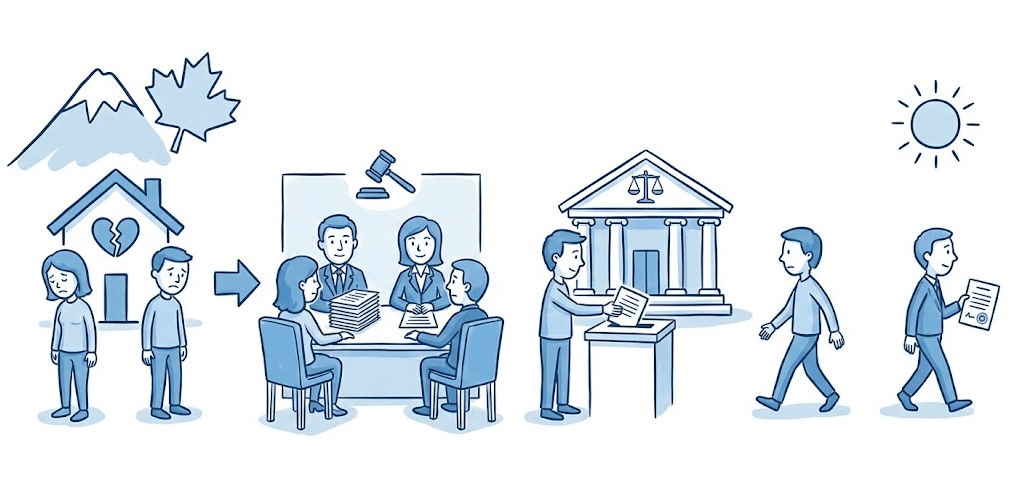
When we mention the word “divorce”, the first thing that comes to your mind may be a friend who is disillusioned with love. Happy people are always similar, while unfortunate people have their own misfortunes. After the divorce, even if he can not talk about the soul, but the frozen property, by the other party to take away the children; was forced to share half of the house, as well as that a glimpse of the endless alimony, this usually optimistic friend can not help but more anxious frown a few points.
Nowadays, with the explosion of information on the Internet, the word “divorce” is slowly losing its dramatic veil, and people are beginning to be more curious about the law behind divorce. This series will lead you to analyze divorce in Vancouver from the perspective of a professional lawyer. However, please note that this article is only intended to provide you with legal knowledge and is not intended to be a legal opinion on behalf of a lawyer. Every family's situation is not similar, so please call us if you have any questions.
Characteristics of Family Litigation
In recent years, due to the influence of various TV shows, when the word “litigation” is mentioned, it seems as if a lawyer in a suit appears in front of everyone's eyes, talking in a courtroom. The trial has its ups and downs, and in the end, the lawyer wins the case with his wits and cries tears of joy with his client. The losing party, on the other hand, beats his chest in remorse.
In the real legal world, it's true that many lawsuits have winners and losers, such as in a civil dispute where the tenant wins and gets to stay in the house, while the landlord wins and the tenant has to pack up and leave the house. In a criminal dispute, for example, the prosecutor will pull out all the stops to prove the defendant's guilt, and if the defendant wins, he can leave the courthouse strutting and humming a little tune. If the defendant loses, a dark, dark day in jail awaits him.
But family litigation is arguably a very unique legal system.
For one thing, in family litigation, there is less of a clear sense of feedback as to whether you win or lose, and the outcome of a lengthy lawsuit is more akin to a zero-sum game in game theory. In some cases, winning or losing the case may mean that he gets the house, or that he is not responsible for the family debt. But in many more cases, especially when children are involved, even if one party gets a result that exceeds his or her expectations, in the long run, assuming that both parties leave their assets to their children after a number of years, a lot of the assets that are left to the children are lost in the long divorce proceedings.
Additionally, the subjective determinations of the parties will be particularly important in family litigation. In a criminal proceeding, the judge will determine from an objective point of view whether or not the third party committed an assault on the defendant. However, in a family lawsuit, everyone's subjective perspective will be taken into account by the judge, and even end up directly affecting the direction of the case.
Please put yourself into the following situation.
It's the first day of court in your divorce lawsuit against your Korean ex-husband. You are sitting in the car on the way to the court, and the snow drifting outside the window makes it difficult for you to see the road in front of you or your future.
At 9:45 a.m., lawyers from both sides arrive at the courtroom, and your attorney takes a seat in the chair next to you, exchanging pleasantries about today's cold weather while organizing the materials for the lawsuit. Not long after, as a kind-faced grandmother walked into the courtroom, the lawyers of both sides rose and bowed, opening the formal proceedings.
Vancouver is a diverse city, where you can see friends from all over the world, with different skin colors. Even though your lawyer has emphasized to you that Canadian judges will never be racially biased or otherwise sensitive, halfway through the trial, your worst fears come to a head.
The man claimed that you were not doing your job as a mother by teaching your child, for example, you would ask him to lift his bowl up in front of him when you ate with him, and this seemed very uneducated to the man from Korea. You can't help but be dismayed after hearing this, there is nothing wrong with this type of teaching of eating in Chinese culture, is there? You turn your head to look at the judge at this point, only to see her previously kind face at this point is also frowning, looking confused.
As you can see from the case above, unlike divorce proceedings in China, Canada, due to its diverse population, each family's unique cultural background and unique subjective perspective can make the entire process more complicated, which also explains the high cost of divorce proceedings in Canada. So instead of expending a lot of energy popularizing the Chinese dinner culture to the judge, most of the marital disputes in Canada are opted to have an out-of-court settlement talks to wrap up the process.
According to the authors, if you want to better resolve legal disputes in the family, then the most important thing is to keep an overlooking view.
Keeping an elevated view allows you to put yourself in the judge's shoes, which not only gives you a clearer picture of what the parties are arguing about, but also allows you to weigh whether there are ways other than going to court that would be more efficient in resolving the dispute between the parties.